
To learn nursing is not limited only to studying as one needs to understand how the process of learning occurs. Are the classes practical enough? What does the laboratory work involve? What about the first lesson on learning how to deal with the patients?
All those who would like to enter Narayan Swaroop Nursing College Prayagraj should be informed about the schedule in nursing colleges.
The nursing education and para-medical education combines theoretical classes, practical classes, communication classes and professional classes. The schedule depends on the program and the academic year but normally it includes lectures, laboratory classes, working in groups and clinical practice.
Let’s see what it gives to the students.
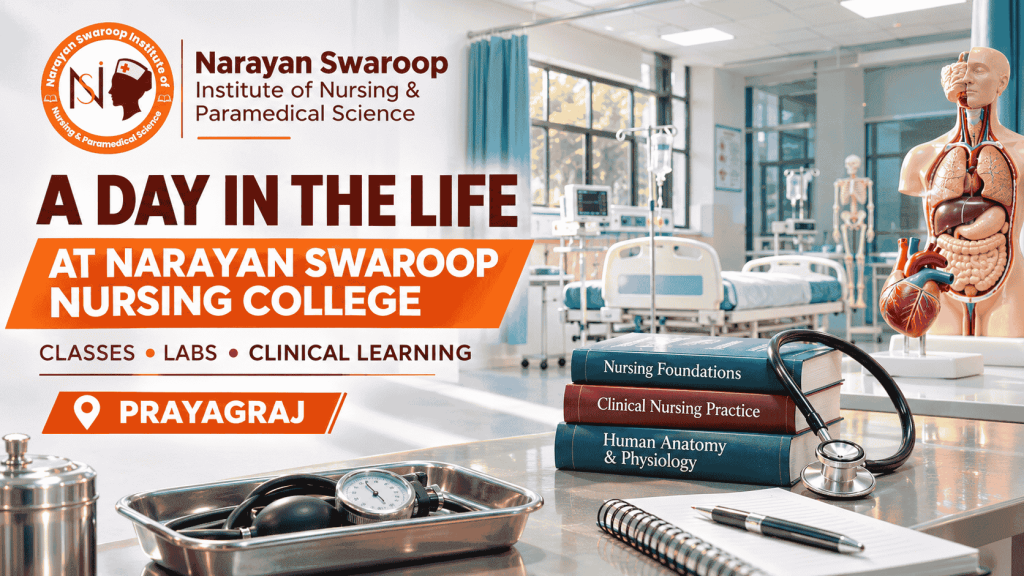
A Day in Narayan Swaroop Nursing College Prayagraj
Nursing students’ day-to-day activities extend further than just going to class and working on assignments. Every task that students undertake during learning is significant because it helps them gradually get used to their responsibilities in the medical sector.
Future nursing students at Narayan Swaroop Nursing College Prayagraj should confirm the current schedule and activities undertaken in the training.
Tasks that nurses usually undertake include:
| Learning Activity | What Students May Learn |
|---|---|
| Classroom Lectures | Medical concepts, nursing principles, and patient care |
| Practical Laboratory Sessions | Basic nursing procedures and equipment handling |
| Group Discussions | Communication, teamwork, and problem-solving |
| Clinical Learning | Patient observation and supervised care |
| Assignments and Revision | Understanding and reviewing important concepts |
The combination of these activities helps students connect classroom knowledge with practical healthcare situations.
Morning Classes: Building Strong Healthcare Knowledge
The initial activity in the academic schedule of a nursing student is classroom learning.
The teacher provides explanations on crucial subjects with the help of illustrations, presentations, and discussions. Thus, the students gain insight into the functioning of the human body and the work of healthcare specialists with their patients.
Understanding Crucial Nursing Subjects
Depending on the course and term, students can study:
- Anatomy – A branch of biology which studies the structure of the body.
- Physiology – Functions of particular organs.
- Fundamentals of Nursing – Basic patient care.
- Microbiology – Microorganisms and diseases.
- Nutrition – Importance of eating proper food.
For example, a class on blood pressure will feature the explanation of the meaning of particular numbers and the reason why health specialists measure them.
Academic knowledge ensures safety in practice.
Practical Laboratory Sessions: Learning Through Practice
Practical Training is a necessary part of nursing and paramedical training.
For people visiting Nursing and Paramedical Institute in Prayagraj, it is very important that one should understand how practical training supports theoretical training.
It is possible for a person to perform basic tasks in a regular nursing lab with the help of suitable training equipment.
What Happens in Practical Classes?
The usual things that happen include:
- Taking temperature, pulse rate, and blood pressure measurements.
- Proper hand washing skills.
- Basic patient positioning skills.
- Bed making skills.
- Infection prevention skills.
- Proper equipment handling skills.
For example, after learning about blood pressure in class, one can perform blood pressure measurements in the practical classes using a blood pressure monitoring tool.
Practical classes help in the development of precision and professional skills.
Clinical Learning: Understanding Real Patient Care
The clinical experience is an important aspect of nursing education because the students will get an opportunity to learn how theoretical knowledge will be applied in practice.
If the curriculum approved will provide such an opportunity, then it will be possible for the students to do this with the supervision when the clinical training is well organized.
This will give the students an opportunity to acquire skills in handling patients, working in hospitals and collaborating in health care.
Skills Acquired from Clinical Training
The skills include the following:
- Observation and reporting of the patients.
- Respectful communication with the patients.
- Understanding of nursing documentation principles.
- Understanding of hygiene and infection control measures.
- Collaboration with the health care practitioners.
- Understanding of patient confidentiality.
The clinical training has to be done according to the competence level of the student, supervision required and the policies of the institution.
Before joining the course, the students will need to know the policies of the institution on clinical training.
Group Activities and Communication Skills
Medicine is not an isolated field. Nurses, doctors, laboratory technologists and other health professionals collaborate in the interest of the patients.
This is something that the students can learn from in terms of communication and working together in class.
For instance, the students can talk about how to assist the old patient in moving around.
It will make it easier for the students to think about the comfort, safety and dignity of the patient.
Communication is very essential in any health care field.
Afternoon Learning: Assignments and Skill Improvement
Once the students have completed the class work and practical training, they will be able to make some revisions of their classes, do their assignments, or seek help from the tutors in case of any problem they might be facing.
Revision is highly critical especially in health care classes because the subject matter covers topics which are based on previously acquired knowledge.
The following are some of the ways through which the students will be able to understand the subject better:
Practical journals
Acquisition of medical terms
Clarifications
How Nursing and Paramedical Learning Differ
There are some specific issues that the people considering to pursue a career in healthcare should have knowledge about in regards to nursing education and paramedical education.
For example, in nursing education, one is taught about topics like patient care, health assessment, communication, and nursing skills.
Paramedical education largely depends on the kind of course being taken; however, it normally includes topics related to healthcare skills of that particular course.
Some of the examples of laboratory courses include the courses that involve diagnosing the patients using laboratory tests and radiology courses.
What Students Should Check Before Admission
The students looking for Private Nursing Colleges in Prayagraj are advised to evaluate different colleges on the basis of realistic educational parameters rather than promotional aspects.
Some basic points of checklist are listed below:
- Ensure the list of current courses.
- Check the specific requirements for each course.
- Check the recognition and affiliation status.
- Know the curriculum and duration of each course.
- Inquire about practical and clinical facilities.
- Ask about the current fee structure and admission procedure.
- Know about the necessary documents and admission process.
As for Nursing College Admission in Prayagraj, the eligibility criteria and admission procedure may vary according to the program and session of admission.
Frequently Asked Questions
1. What happens in a day in a nursing college?
Some of the activities that may happen each day include lecture, practical sessions, assignment writing, discussions and guidance learning among other things according to the scheduling of the college.
2. Are there any practical classes in nursing education?
Yes, there are practical classes in nursing education. Practical lessons, facilities and clinical practices vary according to the different programmes.
3. Are there any clinical classes in nursing education?
Yes, there are clinical classes in nursing education. Clinical classes are very useful in helping the nursing students to get some experience in managing patients, safety measures and professionalism among other things.
4. Can class 12 students join nursing programmes?
Yes, they can join some nursing programmes. It differs according to the programmes.
5. How does a potential student know about Narayan Swaroop Nursing College?
The potential student needs to ask the college itself.
Conclusion
Everyday life in nursing education consists of theoretical learning, practical skill training, and professional learning.
As students reflect on joining Narayan Swaroop Nursing College Prayagraj, it would be apparent that being involved in such learning activities can help them learn something about healthcare education.
If they wish to join the college, they have to consider what their career choices are, what courses they are eligible to pursue, and the requirement of training.
Students are suggested to contact the college for further details.