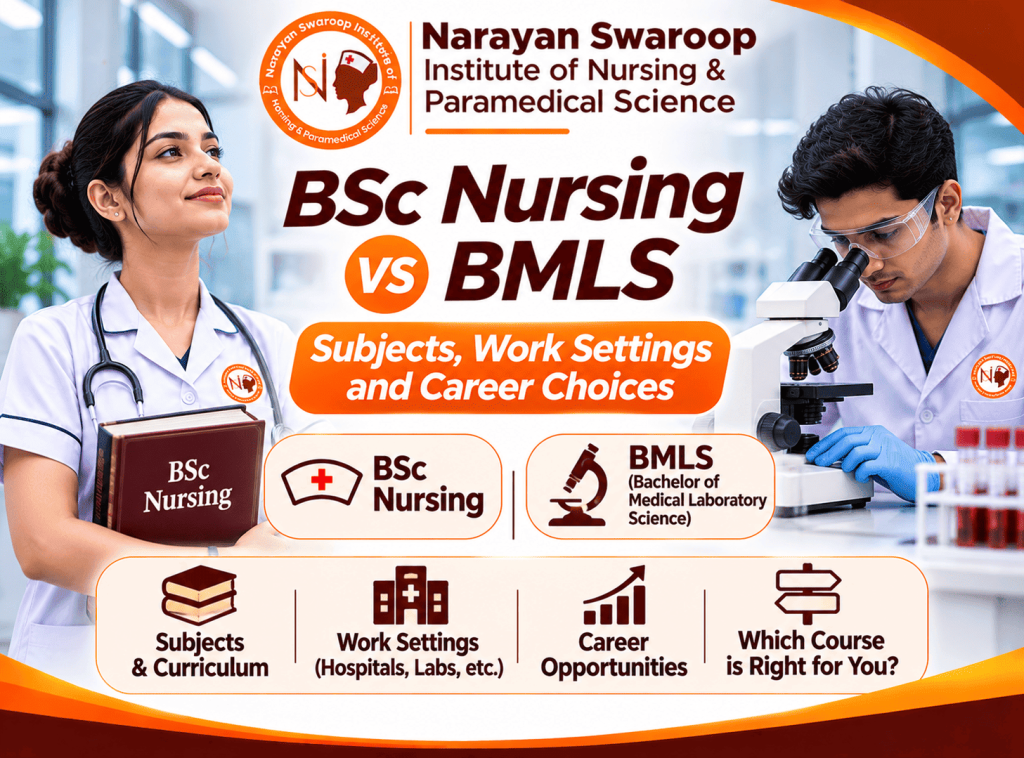

Choosing between BSc Nursing vs BMLS is not simply a decision between two healthcare degrees. One pathway centres on direct nursing care, while the other centres on the laboratory investigations that support clinical decisions. Both contribute to healthcare, but the daily work, training environment and professional responsibilities are substantially different.
If you enjoy biology, that interest alone will not tell you which course suits you. Consider whether you prefer communicating with patients during care or analysing specimens and reporting carefully controlled laboratory results. This guide focuses on those differences rather than repeating a general nursing admission guide.
1. What does each qualification prepare you to do?
A BSc Nursing programme develops the knowledge and clinical judgement required for nursing practice. Depending on training stage, learners study patient assessment, nursing foundations, medical-surgical care, community health, mental health and other areas. Registered nurses work within legal scope, organisational policies and the clinical team’s decisions.
BMLS stands for Bachelor of Medical Laboratory Science. It focuses on laboratory methods used to investigate health conditions, including clinical biochemistry, haematology, microbiology and pathology-related techniques. Laboratory professionals help produce reliable test results, but do not independently diagnose patients merely because they can run an investigation. The distinction between generating evidence and making a medical diagnosis matters.
2. Compare the learning environment
Nursing students spend time in skills laboratories, classrooms and supervised healthcare settings. They learn how to record observations, communicate changes, document care and respond appropriately under supervision. A large part of learning is interpersonal: listening to patients, explaining basic procedures and coordinating with other professionals.
BMLS students spend more time learning specimen handling, laboratory equipment, biological testing principles, record keeping and quality assurance. They must understand how a sample can become unsuitable through incorrect collection, delay, contamination or labelling. Although they communicate with colleagues and sometimes patients, analytical accuracy and controlled processes are central to the role.
3. Look closely at the subjects
A nursing curriculum may include anatomy, physiology, microbiology, nursing foundations, pharmacology, community health, medical-surgical nursing and clinical practice, following the university’s programme design. The four-year BSc Nursing course page) outlines subjects used by Narayan Swaroop Institute.
The institute’s laboratory science programme lists subjects such as biochemistry, haematology, immunology, histopathology, instrumentation and laboratory management. Course titles, durations, internship structure and assessment arrangements must be verified with the college and the relevant academic authority. A similar subject name does not mean the depth or professional outcome is identical across degrees.
4. Compare an ordinary working day
Imagine a hospital patient who needs observations and blood investigations. The nurse may monitor the patient’s condition, document changes, provide prescribed care and coordinate with the clinical team. Separately, an authorised laboratory professional processes the properly labelled specimen, checks analytical quality and reports findings through the laboratory’s established system.
Both are part of the patient’s care pathway. However, the nurse’s work is organised around ongoing care and direct interaction, whereas the laboratory professional’s work is organised around specimen integrity, test performance and reporting. Neither job is ‘easier’ because the other involves fewer patient conversations. The type of responsibility simply differs.
5. Consider working conditions and personal fit
Nursing roles can involve shift duties, physical movement, emotionally difficult interactions and urgent decisions. Strong communication, empathy, teamwork and clinical discipline are essential. Someone who dislikes every form of patient contact should think carefully before choosing nursing solely because friends recommend it.
Laboratory roles can involve repetitive precision, time-sensitive processing, protective equipment, sample tracking and strict adherence to procedures. Students who enjoy instruments, biological analysis and careful documentation may find this environment more satisfying. However, work settings vary by employer. Neither degree guarantees a government job, a fixed salary or a particular shift pattern.
6. Compare admission and professional recognition
Basic BSc Nursing has published Indian Nursing Council entry criteria, including Class 12 science with PCB and English and the applicable marks requirement. Nursing admission also follows the relevant university or state process. The INC eligibility page is a useful regulatory starting point.
BMLS entry requirements and recognition arrangements must be checked for the specific qualification, institution and applicable healthcare education framework. Do not copy BSc Nursing eligibility into a laboratory science application. Ask the institution which university awards the qualification, how the programme is recognised and what the current admission process requires.
7. Which choice makes sense for you?
Choose nursing for a genuine interest in direct care, patient communication and clinical responsibility. Consider BMLS if you are attracted to scientific measurement, diagnostic laboratory systems, technical accuracy and behind-the-scenes support for care teams.
A practical decision exercise is to write down three activities you want to do, three conditions you would find difficult and three questions about employment. Compare your answers against the curriculum and training opportunities of each course. If permitted, attend an official campus orientation or speak with qualified faculty about realistic tasks. Avoid decisions based only on promotional claims about demand.
8. Questions to ask a college before admission
Request the exact programme name and qualification awarded. Ask for the course structure, practical training arrangements, laboratory facilities and complete fee schedule. Confirm applicable affiliation or recognition and whether any registration requirements apply after graduation. Ask how assessments are conducted and whether the teaching language meets your needs.
The Narayan Swaroop Institute website lists both nursing and laboratory science pathways. Its address is G.T. Road, Teramil Kajipur, Kaushambi, Uttar Pradesh, so students from Prayagraj should also estimate transport or accommodation costs. Discuss each programme individually rather than assuming identical arrangements.
Frequently asked questions
Is BMLS the same as BSc Nursing?
No. They prepare graduates for different professional roles. Nursing focuses on nursing care; laboratory science focuses on laboratory investigations and quality-controlled results.
Which course involves more patient interaction?
Nursing generally includes more sustained direct patient care. Laboratory roles vary, but most place greater emphasis on specimens, analyses and reporting.
Can one degree automatically substitute for the other?
No. Eligibility for a professional role depends on the relevant qualification and applicable registration, recruitment and regulatory requirements. Do not assume equivalence.
Make an informed course enquiry
Review the BSc Nursing programme) and the BMLS laboratory course side by side. If you need clarification about training or admission conditions, contact Narayan Swaroop Institute. A careful choice starts with the work you want to do, not a broad claim that one healthcare course is universally better.