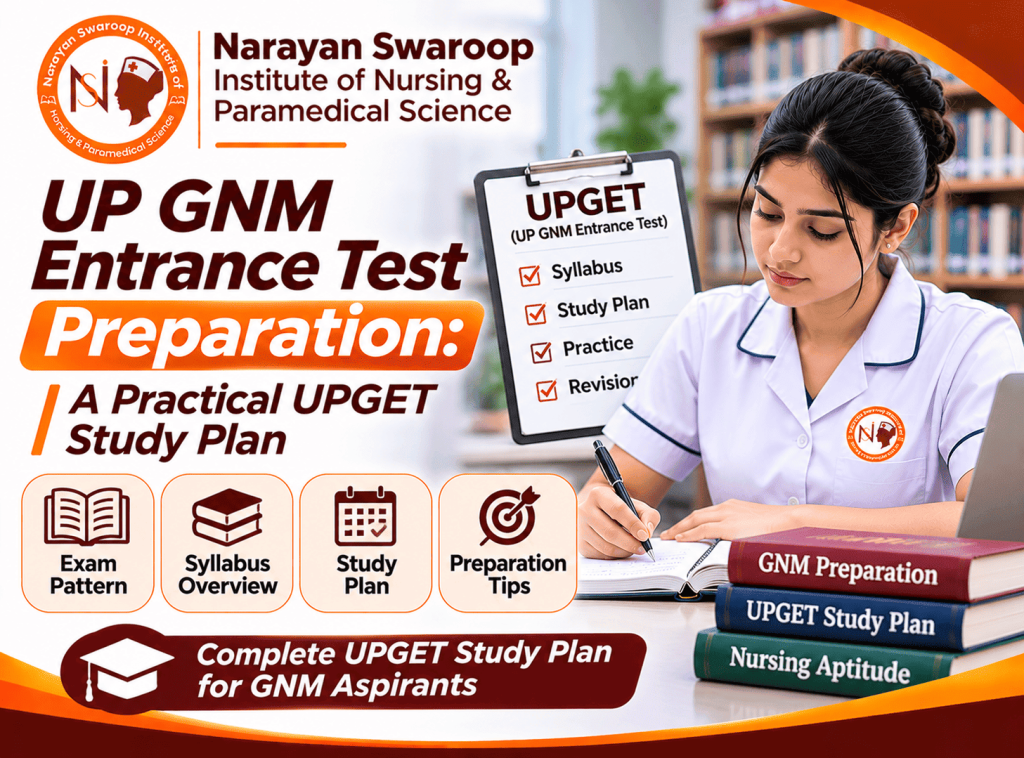

Students starting UPGET GNM entrance exam preparation often face two separate tasks: understanding the admission process and organising daily study. They are related, but not identical. The best starting point is to confirm which examination applies to your intended GNM programme, then build a routine around the official topics and timing.
Atal Bihari Vajpayee Medical University (ABVMU) displayed the UP GNM Entrance Test, or UPGET, for its 2026 GNM admission cycle. That does not establish the dates, syllabus or rules for a later intake. Use the official university website and the bulletin for your admission year rather than a copied coaching notice.
1. Check GNM eligibility before paying an examination fee
The Indian Nursing Council’s published baseline requirements for GNM include Class 12 with English, the prescribed qualifying marks and other applicable conditions. The Council describes science as preferable, rather than making it the only possible school background under its general criteria. Age, fitness and category-related provisions also require attention.
Check the INC eligibility guidance, then read the relevant UPGET bulletin for the rules that govern your application. If your examination board, stream or documentation creates uncertainty, seek clarification from the official admissions authority before submitting a form. Preparing for weeks without confirming eligibility can become a costly mistake.
2. Make a syllabus-first study checklist
Write down every section specified in the current information bulletin and divide each section into smaller topics. Beside each topic, add three marks: ‘new’, ‘needs revision’ or ‘comfortable’. This is more useful than labelling an entire subject as easy or difficult.
If an updated bulletin is pending, use previous-cycle information only for provisional orientation. Do not announce a fixed number of questions from Biology, reasoning, English or general knowledge unless those sections are actually confirmed in the applicable test. Students from different schooling backgrounds may need different levels of basic revision. The checklist keeps your preparation focused on the published requirement, not somebody else’s assumptions.
3. Turn reading into active learning
Reading notes repeatedly can create a false feeling of familiarity. After studying a small topic, close the book and write a five-line explanation from memory. Then solve a short set of questions. Check not only your answers but also the reasons behind them.
For anatomy-related introductory material, start with terminology and the relationship between body systems. For basic healthcare concepts, understand the purpose of hygiene, observation, communication and patient safety rather than memorising isolated phrases. Any exam-specific content should still come from the official syllabus. These methods help you learn efficiently even when your total daily study time is limited.
4. Use a three-part daily routine
Set an achievable daily target. A student with school or family responsibilities might use 30 minutes for revising earlier material, 40 minutes for the day’s main topic and 20 minutes for practice questions. Someone with more time can extend the sessions, but should preserve breaks and review.
At the end of each day, record what you completed and one area that confused you. At the end of the week, compare planned work with actual work. If you repeatedly miss a target, reduce the schedule instead of carrying an ever-growing backlog. A routine you can sustain is better than a schedule designed to impress other people.
5. Build exam confidence using timed practice
Begin with small untimed question sets to develop accuracy. Once the foundation improves, introduce timing gradually. Try a mixed-topic session, note how long each type of question takes and practise moving on when you are genuinely stuck. The goal is to use the official examination duration effectively.
When reviewing, separate careless errors from knowledge gaps. For example, reading a question incorrectly requires a different solution from not knowing the subject at all. Keep a revision list of recurring mistakes. If the applicable marking rules penalise wrong answers, adapt your guessing strategy accordingly; do not assume such a rule without checking the bulletin.
6. Prepare documents and track announcements
Keep your Class 10 and 12 records, identification, photograph and relevant category or domicile documents ready, if applicable. Names and dates must match across certificates. Check document formats and permitted corrections in the current application instructions.
Create a small admissions tracker with columns for application opening, closing date, correction window, examination, result and counselling. Fill those fields only after official publication. Save the source URL beside each entry. This helps avoid outdated dates circulating in social-media groups. Never share application passwords or one-time passcodes with unofficial agents.
7. Understand what the GNM course involves
Preparation feels more meaningful when you understand the education that follows. GNM is a nursing diploma integrating theory and practical learning. The institute’s GNM course page describes foundational sciences, nursing fundamentals, medical-surgical topics and supervised clinical exposure.
Those course subjects are not automatically the UPGET examination syllabus. Keep the two lists separate. To see how placements and supervised practical learning may work, read our GNM clinical training guide. This supports course selection without repeating a full admissions article.
8. A seven-day revision example
On day one, organise official sources and take a short diagnostic quiz. On days two and three, revise weaker topics and practise questions. On day four, revisit your error list. On day five, complete a mixed test. On day six, review its answers carefully. On day seven, summarise progress and set goals for the coming week.
Repeat the pattern with new topics and gradually longer practice sets. Do not measure success only by the hours logged. A more useful measure is whether you can explain the material and answer unfamiliar questions accurately. Keep the final week before an exam for structured revision, not frantic collection of new books.
Frequently asked questions
Is UPGET the same as CNET?
No. The university displayed separate entrance routes for GNM and certain nursing degree programmes in 2026. Always check the applicable year’s notice.
Can a non-science student apply for GNM?
The INC’s general criteria include eligible Class 12 backgrounds beyond science, subject to conditions. The governing admission bulletin must confirm eligibility for your route.
Should I memorise a previous year’s paper?
Use past questions to practise concepts and understand question style, not to predict identical questions. Prior papers are learning material, not guaranteed forecasts.
Explore your GNM options
Students considering study near Prayagraj can review the GNM programme at Narayan Swaroop Institute. The campus address is in Kaushambi, so consider commuting and accommodation as well. For course-specific questions, send an admission enquiry. Entrance registration and university counselling must still be completed through the authorised process.