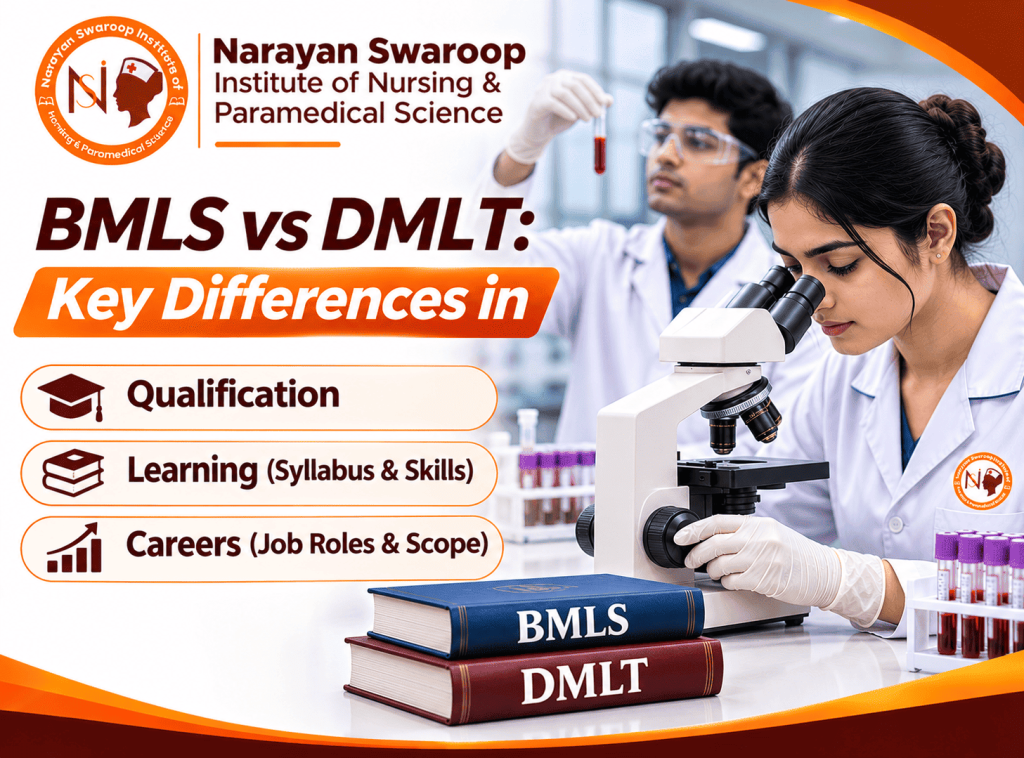

A student interested in diagnostic laboratories may come across two common course names: Bachelor of Medical Laboratory Science and Diploma in Medical Laboratory Technology. Comparing BMLS vs DMLT only by duration or advertising claims can lead to a poor decision. The real differences concern the qualification awarded, depth of study, practical training, recognition and jobs for which a graduate becomes eligible.
Course titles and regulatory arrangements can vary across universities and institutions. Before comparing fees, confirm exactly what certificate or degree each college awards. This guide focuses on questions students should ask, not on claiming every programme in India follows an identical structure.
1. Degree and diploma are different qualification levels
BMLS commonly refers to a bachelor’s-level medical laboratory science programme, whereas DMLT generally refers to a diploma-level medical laboratory technology programme. A bachelor’s programme may provide wider academic study and additional progression options, but that does not make every diploma inadequate.
The precise status of each qualification depends on its awarding institution and applicable recognition requirements. A diploma with good supervised practice may prepare someone for particular entry-level roles, while a degree may be required for other positions or further study. Employers decide eligibility according to published recruitment conditions; course titles alone cannot establish that two graduates can apply for the same post.
2. Compare the curriculum, not just the name
Medical laboratory education can include anatomy, clinical biochemistry, microbiology, haematology, clinical pathology, laboratory instruments and specimen handling. A bachelor-level programme may include deeper theory, laboratory management, quality control and more specialised study, depending on its curriculum.
A diploma may emphasise foundational laboratory methods and routine technical procedures. However, there is no safe shortcut for evaluating depth: request the semester-wise or year-wise syllabus of the two exact programmes. Compare learning outcomes, assessment and supervised laboratory work. The Narayan Swaroop laboratory programme page lists biochemistry, haematology, immunology, pathology-related learning and quality control across its stated structure.
3. Practical training should be examined independently
A large classroom syllabus cannot substitute for appropriate supervised practice. Laboratory learners must understand how to identify samples, record information, use controls, maintain equipment and recognise when results require review by authorised professionals.
Ask how much time is spent on actual instruments, where supervised practical sessions occur and how students are assessed. Find out whether the programme includes a defined internship and what the college does if an assigned facility is unavailable. The quantity of practical time matters, but so do supervision and documented competencies. Never assume students may independently issue reports or interpret diagnostic findings simply because they have operated an instrument in class.
4. Understand quality and patient safety
Clinical laboratories rely on accuracy at every stage: before testing, during analysis and after results are generated. A sample can be affected by incorrect patient identification, unsuitable collection containers, improper storage or transcription errors. A student who understands these risks is learning more than button-pressing.
Quality control, standard operating procedures, documentation and incident reporting are therefore important topics. Ask whether the curriculum includes these principles and whether practical evaluation checks them. These are relevant to both degree and diploma pathways, though the academic depth and responsibility expected from graduates may differ.
5. Compare possible job requirements
Job advertisements may use titles such as laboratory technician, laboratory technologist, laboratory assistant or other institution-specific designations. These names are not interchangeable across every employer. A hospital might require a particular approved qualification; another facility may specify experience, registration or additional skills.
Before admission, collect three genuine recruitment notices for roles that interest you. Highlight the exact educational requirements and check whether your proposed course meets them. Do not accept a claim that ‘100% jobs are available’ as evidence. Ask for verifiable placement information, and remember that eligibility to apply is not a guarantee of selection.
6. Investigate further-study options realistically
Students sometimes choose a bachelor’s qualification because they may later pursue postgraduate study or specialised laboratory-related education. This can be reasonable, but progression depends on the receiving institution’s requirements, not only on the presence of the word ‘bachelor’ in the original course title.
A diploma-holder considering a later degree should ask whether any lateral-entry or credit-recognition route actually exists for that qualification. Do not assume all diplomas convert automatically into the second year of a degree. Request written confirmation from the institution offering the next programme before relying on that plan.
7. Calculate the real education cost
Compare tuition, examination charges, laboratory consumables, uniforms, commuting, hostel costs and the time spent studying. A longer course may involve greater total living costs, even if its annual tuition is similar. At the same time, the least expensive course is not automatically the right option if its qualification does not meet your career goal.
Create two columns headed ‘BMLS’ and ‘DMLT’. Beneath them list the awarding authority, recognised programme name, total duration, practical training, total estimated cost and roles for which graduates may qualify. Mark any unknown detail as ‘to verify’ rather than filling the gap with assumptions.
8. Who should consider each route?
A bachelor’s route may suit students who want extended scientific study and wish to investigate longer-term academic progression. A diploma may suit students whose desired job explicitly accepts that particular qualification and whose preferred study structure matches its training. Neither statement replaces verification of a specific college or vacancy.
Try speaking with a qualified laboratory professional about daily responsibilities such as careful sample labelling, quality checks and working under time pressure. Your interest in scientific accuracy and routine technical work is a more useful indicator than someone else’s claim that one course has unlimited scope.
Frequently asked questions
Is BMLS always three years long?
Do not assume a universal duration. Verify the specific programme’s academic structure and internship with its awarding institution. The Narayan Swaroop site states its own laboratory course structure.
Is DMLT automatically equivalent to BMLS?
No. They are different qualification levels and may have different eligibility outcomes. Specific recruitment or admission rules control equivalence questions.
Can a laboratory graduate independently diagnose disease?
Producing a laboratory result is not the same as making a medical diagnosis. Duties are determined by training, authorised scope and professional supervision.
Explore the laboratory programme
Narayan Swaroop Institute lists a Bachelor in Medical Laboratory Science pathway. Students can request course-specific information about academic duration, practical work and current admission requirements. Get the precise qualification details before comparing it with any diploma offered elsewhere.