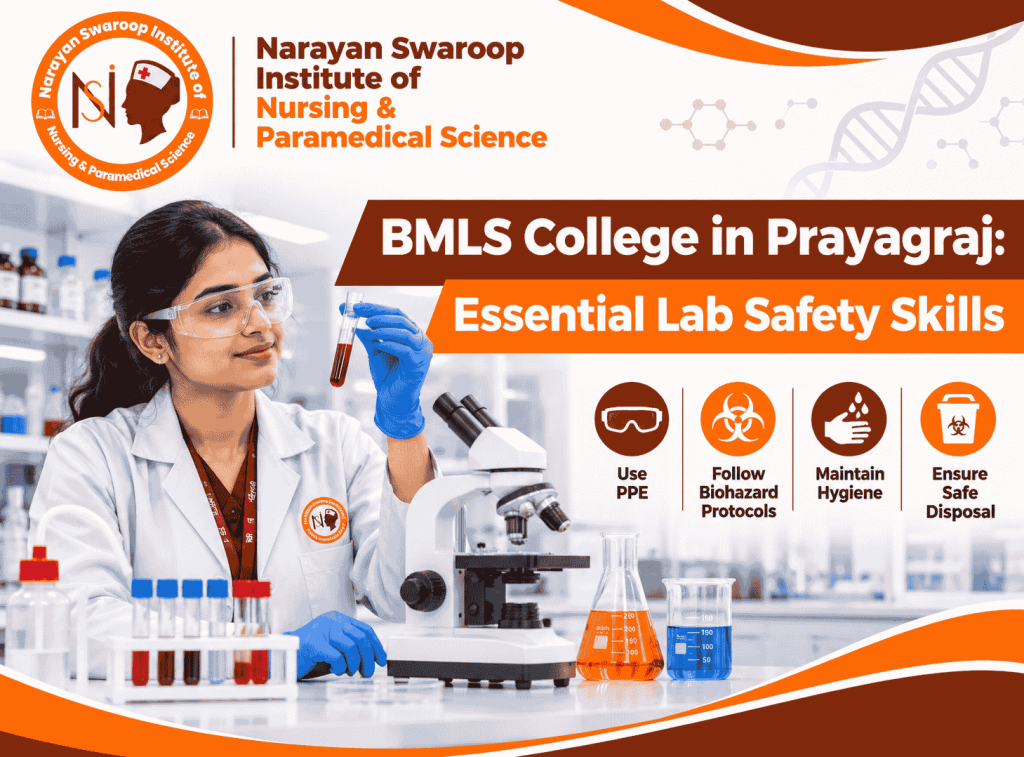

Every medical laboratory sample, instrument and report carries responsibility. Mixing up labels or handling specimens carelessly can affect safety and test reliability. That is why laboratory safety is not an optional topic for students pursuing a Bachelor in Medical Laboratory Science (BMLS).
If you are comparing a BMLS College in Prayagraj, look beyond course names and classrooms. Ask how students learn safe working habits, practise under supervision and understand the importance of accurate documentation. These habits matter throughout a laboratory career.
Why Laboratory Safety Matters for BMLS Students
BMLS students study microbiology, pathology, biochemistry and haematology. Practical activities involving equipment, chemicals or specimens carry different risks.
Safety training teaches hazard recognition and protects sample quality. A contaminated sample, damaged container or incorrect identification can make a result unreliable. Safe practice therefore supports three goals: protecting people, protecting specimens and producing dependable laboratory information.
Essential Laboratory Safety Skills Every Student Should Learn
1. Recognising Hazards Before Starting Work
The first skill is knowing what could go wrong. Biological material may pose infection risks, chemicals may irritate skin or eyes, and glassware or sharp instruments can cause injuries.
Students should read labels, recognise warning symbols, follow instructions and know whom to contact after an accident. Never begin an unfamiliar procedure simply because another student has already tried it.
2. Using Personal Protective Equipment Correctly
Personal protective equipment, or PPE, may include a laboratory coat, gloves, eye protection or other items selected for the task. Wearing more equipment is not automatically safer. The correct choice depends on the activity and its assessed risks.
Students must learn when PPE is required, how to put it on and remove it safely, and why gloves do not replace hand hygiene. Follow laboratory instructions for damaged PPE. Never eat or drink at workstations.
3. Maintaining Hand Hygiene and Clean Workspaces
Clean hands and tidy benches are basic but important habits. Students should follow the laboratory’s hand hygiene requirements, including after removing gloves and before leaving the work area.
Work surfaces should be cleaned or disinfected only with approved products and methods. Keep personal items away from contaminated areas so spills and hazards are easier to spot.
4. Handling and Identifying Samples Carefully
Correct identification is essential in medical laboratory work. Students should understand why authorised personnel verify patient details, label containers properly and match samples with relevant request information.
They must understand containers, transport and storage conditions. If a label is missing or information does not match, the issue must be reported through the laboratory’s procedure. Students should never guess a patient’s identity, alter records or process an uncertain specimen without guidance.
5. Preventing Sharps Injuries and Responding to Spills
Needles, broken glass and other sharp objects require special care. Training should cover safe handling, appropriate disposal containers and immediate reporting of injuries.
Spills must not be treated as routine cleaning jobs. Different materials require different responses. Alert supervisors and follow the approved spill-response plan. Trying an unapproved cleaning method can increase exposure instead of controlling it.
6. Managing Biomedical Waste Responsibly
Laboratories may generate contaminated disposables, sharps, chemical waste and ordinary non-hazardous materials. These should not be mixed together casually.
BMLS learners should understand waste segregation, clearly marked containers and the importance of following the facility’s applicable rules. Disposal procedures vary by waste type and local requirements. Students should follow institutional instructions rather than relying on a colour-code chart found online without checking its relevance.
7. Keeping Accurate Records and Reporting Errors
Good laboratory practice includes clear records. Students should record what they actually observed during approved practical sessions, follow documentation formats and protect patient confidentiality.
If an instrument behaves unexpectedly or a sample seems unsuitable, reporting the problem promptly is more professional than hiding it. Laboratory safety depends on communication and accountability as much as technical ability.
How the BMLS Course Builds Practical Awareness
The BMLS Course in Prayagraj search often leads students to compare subjects, practical sessions and internship opportunities. Practical learning matters because safety principles become meaningful when students understand why each instruction exists.
For example, a microbiology lesson can introduce contamination risks, while haematology practicals can demonstrate the importance of specimen quality and accurate records. Students should participate only in tasks permitted by their training level and supervised by authorised instructors.
At Narayan Swaroop Institute of Nursing & Paramedical Science, the published Bachelor in Medical Laboratory Science course page lists laboratory techniques, microbiology, haematology, instrumentation, quality control and practical training. The institute’s listed campus address is in Kaushambi, near Prayagraj. Students should confirm current training arrangements directly before applying.
Choosing a Programme That Takes Safety Seriously
If you are researching Bachelor in Medical Laboratory Science in Prayagraj, ask practical questions before admission. Who supervises laboratory sessions? What safety orientation do new students receive? How are incidents reported? What practical records are expected, and what internship arrangements are available?
Practical answers matter. To understand one related subject in greater depth, read our BMLS haematology practical training guide. For application information, see the BMLS admission guide.
Frequently Asked Questions
What is the most important safety skill for a BMLS student?
Recognising risks and following approved procedures are foundational. Correct identification, hand hygiene, PPE and prompt reporting all support safer work.
Do BMLS students need PPE during every practical?
PPE requirements depend on the activity and the laboratory’s risk assessment. Students must follow their instructor’s directions rather than assume the same equipment is suitable for every task.
Can students handle patient samples independently?
Not simply because they are enrolled in BMLS. Handling clinical specimens requires appropriate training, authorisation, supervision and laboratory procedures.
Why is biomedical waste segregation important?
Separating different types of waste helps reduce exposure risks and supports safe treatment and disposal according to applicable rules.
Conclusion
Laboratory safety is a professional habit built through repeated, supervised practice. Students who learn to identify risks, protect specimens, maintain hygiene and report errors are better prepared for responsible laboratory work.
When selecting a BMLS College in Prayagraj or a nearby institution, evaluate the quality of practical guidance alongside the syllabus. To explore the programme at Narayan Swaroop Institute of Nursing & Paramedical Science, review its official course details and contact the admissions team for current information.
Safety reference: WHO Laboratory Biosafety Manual, 4th edition. This article is educational and does not replace institutional safety protocols or supervised training.