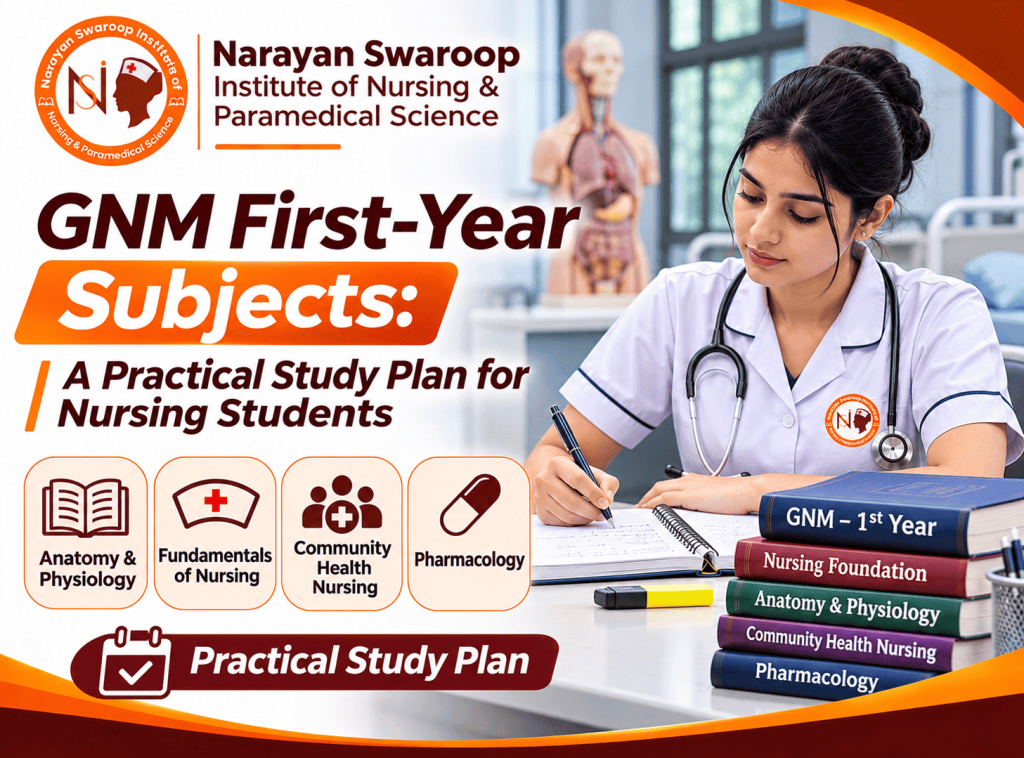

Starting a nursing diploma introduces unfamiliar terminology, practical expectations and a more structured way of studying than many students experienced at school. A practical GNM first year subjects study guide should show how anatomy, microbiology, nursing fundamentals and other foundational topics support clinical learning. It should also explain how to study them without treating every chapter as an isolated memory exercise.
The exact timetable and assessment scheme depend on the institution’s approved curriculum. Narayan Swaroop Institute’s GNM course outline lists foundational sciences, first aid, personal hygiene, psychology, sociology, community health and nursing fundamentals in its first-year overview. Confirm the current syllabus with faculty before buying reference books.
1. Anatomy and physiology: learn the body as a system
Anatomy introduces structures such as organs, tissues and major body systems. Physiology explains their functions. Students should not try to memorise the names of every structure before understanding basic orientation and relationships.
Create a notebook with one page per system. Include a simple diagram, important terms, core functions and two short questions. When studying breathing, for example, explain the movement of air and the purpose of gas exchange in plain words. When studying circulation, connect heart chambers and vessels to the direction of blood flow. These connections support later nursing subjects and improve answers in oral examinations.
2. Microbiology: focus on why safety steps matter
Microbiology introduces microorganisms and concepts related to infection and prevention. It is tempting to memorise definitions without understanding how contamination can occur. A better approach is to link each concept to a safe behaviour in a healthcare setting.
Learn the difference between cleaning, disinfection and sterilisation, and why hand hygiene and appropriate protective equipment matter. Use the WHO infection prevention learning resources for trustworthy background. Students must follow their training institution’s actual procedures during practical sessions; a blog explanation is not an authorisation to perform clinical tasks independently.
3. Fundamentals of nursing: understand the reason for each step
Nursing fundamentals cover introductory principles of patient care, communication, observation, safety and documentation. Rather than memorising a skill list mechanically, ask what the procedure protects, what information must be communicated and which mistakes could create risk.
Before a supervised laboratory demonstration, read the approved checklist and identify required equipment. During practice, follow the instructor’s sequence and ask about unfamiliar steps. Afterwards, write a concise reflection: what you did correctly, what needed improvement and what the safety lesson was. This turns practical learning into a repeatable improvement process.
4. Psychology and sociology: study real situations
Psychology helps learners understand behaviour, stress and communication. Sociology introduces how family, community and social conditions can influence experiences of health and care. These areas are not less important merely because they contain fewer diagrams.
Use respectful, non-identifying examples. Imagine a patient who is anxious about an unfamiliar hospital routine. Think about how clear explanations, attentive listening and privacy can improve communication. Never record actual patient identities or private information in personal study notes. Link theoretical ideas to professional empathy without assuming that students can diagnose psychological conditions.
5. First aid and community health: keep practice supervised
First aid principles introduce immediate recognition, basic response and the importance of requesting appropriate help. Community health develops awareness of prevention, education and services beyond hospital walls. The exact practical skills students may demonstrate depend on their curriculum and supervision.
Learn the purpose of emergency reporting, personal safety and timely escalation. For community topics, draw simple maps of local health services or create educational posters using verified public-health messages. Do not learn hazardous emergency procedures solely from internet summaries. Practical competence requires authorised instruction, supervised assessment and updated guidelines.
6. Make a weekly plan that supports retention
Divide the week into new learning, active recall, written practice and supervised skills review. For example, use two days for anatomy and physiology, one for microbiology, one for nursing fundamentals, one for behavioural or community subjects and a weekend review session.
At the start of each week, identify three achievable learning outcomes. At the end, try to explain them without notes. If you cannot, decide whether you need another diagram, a clearer definition or help from a teacher. An hour spent correcting misunderstandings can be more productive than several hours copying a textbook.
7. Improve your GNM exam answers
For short questions, begin with an accurate definition and write the essential points requested. For longer questions, structure the response with headings, explanations and relevant examples. Use neatly labelled diagrams where appropriate and avoid adding unrelated details only to increase answer length.
Practical and viva assessments require separate preparation. Ask faculty which skills are assessed and how performance is marked. Rehearse terminology and reasons for each approved step, then seek feedback during practice. Do not assume a popular online ‘important questions’ list matches the current examination scheme.
8. Avoid four early study mistakes
First, do not wait until internal exams to organise notes. Second, avoid studying science subjects only by memorising answers. Third, do not ignore feedback from practical sessions. Fourth, avoid comparing your pace constantly with classmates who have different learning backgrounds.
Keep a glossary of unfamiliar clinical terms and revise it regularly. Work with a small study group if members genuinely discuss concepts and correct mistakes. When something remains confusing, show the exact question to an instructor. Early clarification prevents misunderstandings from carrying into later clinical learning.
Frequently asked questions
Is the first-year GNM syllabus identical in all colleges?
Core expectations are influenced by applicable standards, but consult your institution’s approved syllabus and current academic calendar for the actual subject arrangement and assessments.
Do I need to memorise entire textbooks?
No. Understand learning outcomes, definitions, relationships and assessed procedures. Use active recall and faculty feedback to direct revision.
Can first-year students independently provide patient care?
Students must work within their training level, approved scope and supervision. Reading about a procedure does not make independent practice safe or authorised.
Explore the full programme
The GNM course information page explains how later study broadens toward medical-surgical and other nursing areas. Students considering admission can contact the college for current requirements and curriculum questions. A strong first year is built through steady revision, safe skills learning and asking precise questions.