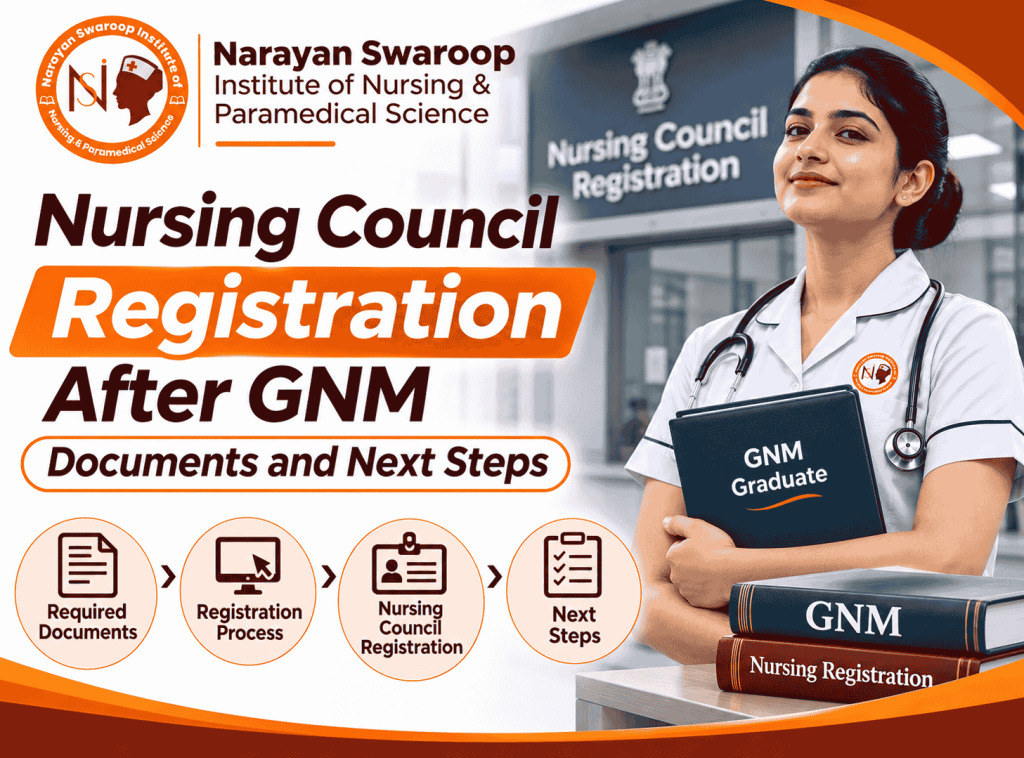

Completing a nursing diploma and obtaining professional registration are connected but separate milestones. Students asking about nursing council registration after GNM should first identify the relevant State Nursing Registration Council, understand its current process and prepare accurate educational documents. Registration should not be treated as an automatic reward for passing final examinations.
Rules, portals, fees and processing steps may change, so this guide provides a planning framework rather than a promise of immediate registration. Always follow the current instructions published by the responsible council and your recognised educational institution.
1. Understand why registration matters
GNM education is intended to prepare students for nursing work within the applicable professional framework. State Nursing Registration Councils administer professional registration processes under relevant rules. Employers and further-study institutions may require an appropriate registration credential in addition to the academic diploma.
The Indian Nursing Council’s nursing programmes overview lists GNM alongside its nursing registration category. That does not mean a graduate can practise before satisfying the applicable registration requirements. The exact legal rights, designation and employment eligibility depend on current rules and relevant authorisation.
2. Confirm which council handles your application
Your training institution should provide guidance on the council and process relevant to your qualification. Do not assume that every nurse in India applies through one central online portal. A student trained in one state and planning employment in another may need to understand additional registration or reciprocal arrangements.
Ask your college for the official council name, website and applicable applicant category. Check whether the process is initial registration, renewal, transfer or addition of qualification. These categories are not interchangeable. Follow the council’s own instructions, and confirm any special case directly with the authority rather than using an unofficial service claiming a shortcut.
3. Check your academic records for consistency
Before beginning, gather your GNM completion documents and verify names, dates and qualification details. Compare the spelling of your name and parents’ names across the application, identity document and academic certificate. If something differs, ask the issuing body what correction procedure applies.
Students sometimes discover a mismatch only when submitting an application. Keeping a clear folder early can prevent that. Do not edit a scanned certificate to ‘correct’ information yourself. Use lawful amendment procedures and obtain an authentic updated document where required.
4. Prepare a provisional documents checklist
The applicable council may ask for qualification records, examination details, photographs, identity proof, internship-related confirmation or other supporting material. The required items depend on its current process and the type of registration.
Create a checklist from the official portal before uploading anything. Note accepted file formats, size limits, identity requirements, payment method and whether original verification is required. Keep physical originals available but do not send them to an unknown intermediary. A generic internet list is only a starting point, not an authoritative statement of the council’s requirements.
5. Apply through the verified official process
Open the authentic council website and locate the correct registration category. Enter all academic details carefully, using the precise institution and qualification names on your records. Review the form before submission, particularly dates and registration category.
Pay only through the permitted method and save the transaction receipt, application acknowledgement and reference number. If a correction facility exists, use it according to the official instructions. Avoid repeatedly submitting duplicate applications because a status page has not changed. Check the published support contacts for genuine technical problems.
6. Understand verification and follow-up
An application may require scrutiny of educational records or confirmation from the institution. The council may request additional information or an original-document check. Follow the published process and respond only through official channels.
Maintain a simple tracker with application date, reference number, documents submitted, communications received and current status. If a deadline is specified, act before it expires. Do not assume that a payment receipt is the same as a final registration certificate. Keep the distinction clear when providing documents to an employer or university.
7. Plan employment steps realistically
Different job advertisements may specify particular educational qualifications, registration credentials, experience or other conditions. Before applying, read the recruitment notice in full and compare it with the registration status you actually hold.
Avoid advertisements that promise guaranteed nursing posts after submitting an unverified registration fee. Public recruitment, private employment and overseas professional licensing all have separate processes. Nursing council registration in one jurisdiction does not automatically authorise independent practice in every country. Seek reliable guidance for the destination and role.
8. Consider Post Basic BSc Nursing as a separate step
Eligible GNM graduates may consider the Post Basic BSc Nursing pathway for further education. The Indian Nursing Council’s eligibility guidance includes a GNM certificate and RN/RM registration with a State Nursing Registration Council among the conditions for that programme.
That makes correct documentation important for academic progression as well as professional records. However, Post Basic admission may involve a university entrance examination and counselling; registration alone does not guarantee a seat. Our BSc Nursing after GNM guide explains the degree pathway separately.
9. Avoid common registration mistakes
Do not use a lookalike website, share an OTP with an agent or pay a personal account without verification. Do not guess a missing certificate number, attach a mismatched document or assume an old fee schedule remains valid. Most importantly, do not describe yourself as registered until the competent authority has actually granted the relevant status.
If your institution’s staff assist with forms, still review the submitted information personally. Keep credentials private and retain copies of official acknowledgements. When a rule is ambiguous, ask the council directly and save the written response.
Frequently asked questions
Is GNM completion the same as registration?
No. Academic completion and professional registration are distinct requirements handled through relevant institutions and councils.
Can I register with any State Nursing Council?
The appropriate application route depends on your training, existing records and the relevant council’s rules. Verify your specific case before applying.
Does registration guarantee a nursing job?
No. Employment depends on vacancies, selection requirements, qualifications and other conditions set by the employer.
Plan your academic pathway
Narayan Swaroop Institute lists a GNM programme and a two-year nursing degree pathway). Prospective students may enquire about the courses. For any actual registration application, follow your State Nursing Registration Council’s official instructions.