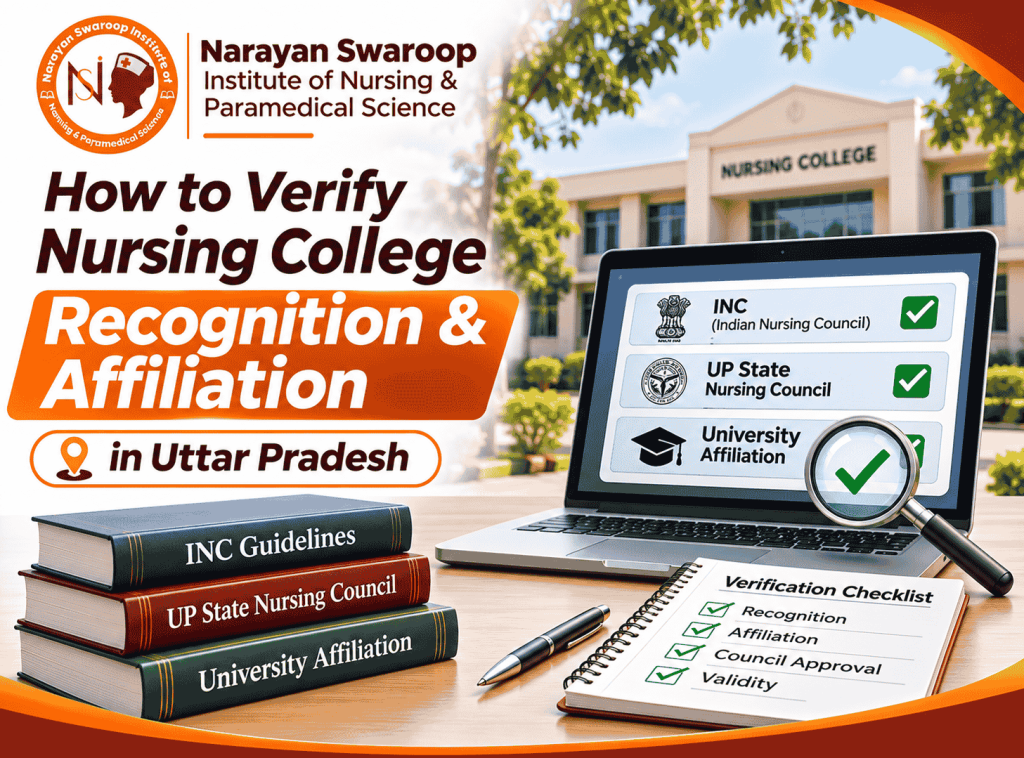

Before paying a nursing college admission fee, students should know exactly who awards the qualification and whether the relevant programme meets applicable regulatory requirements. Searching for nursing college recognition in UP can produce promotional claims, directory profiles and screenshots, but these are not equally reliable forms of evidence.
A college may offer several programmes with different approving authorities and conditions. Recognition, affiliation and permission to participate in a particular admission process are related questions, not one interchangeable label. This guide explains how students and parents can check them carefully.
1. Distinguish recognition, suitability and affiliation
A university affiliation concerns the academic relationship under which teaching and qualifications are governed. Nursing education also involves statutory and regulatory requirements that depend on the programme and relevant authorities. The Indian Nursing Council maintains information about recognised qualifications, nursing standards and institutional suitability processes.
A college website may state that it is ‘approved’ without specifying the programme, academic year or issuing authority. Ask what the statement means and request the exact reference. Do not assume that permission for BSc Nursing automatically covers GNM or another programme. The key is to verify the precise course you intend to join, not the institution’s marketing headline.
2. Identify the exact legal institution name
Start by recording the college’s full legal name, address, proposed course name and academic session. Names on brochures, domain names and university records may differ slightly. Matching the address and institution identifiers can help avoid confusing similarly named colleges.
Narayan Swaroop Institute of Nursing & Paramedical Science lists its campus at G.T. Road, Teramil Kajipur, Kaushambi, Uttar Pradesh. A page optimised for students from Prayagraj should not imply the campus is physically inside Prayagraj city. Location matters for checking official records, commuting and admission correspondence.
3. Check information from the Indian Nursing Council
Visit the Indian Nursing Council website and look for institutional notices, suitability information, regulations and relevant public lists. The Council’s documents may use specific terminology or refer to a particular academic year. Read the document title and date rather than judging from an old screenshot.
If the college’s name does not appear immediately, do not jump to a conclusion. Public lists may use a different legal spelling, may be updated periodically or may require checking the relevant State Nursing Council and university records. Request official clarification before accepting or rejecting a claim. Never fabricate a recognition number for a brochure or blog.
4. Check the university or awarding authority
Ask which university, examination board or authorised body awards the qualification. Then check its official website for current affiliated-institution information or programme listings. In Uttar Pradesh, Atal Bihari Vajpayee Medical University publishes nursing admission and academic information for programmes within its remit.
Not every health education programme necessarily uses the same university process. For GNM, nursing degrees and allied-health courses, the applicable authority can differ. Confirm the relationship for the exact course and academic year rather than assuming that every programme shown under one website menu follows identical rules.
5. Verify admission participation separately
Even after checking institutional status, confirm how students are admitted to the desired course. The authority may require an entrance examination, counselling registration, allotment or other steps. A college-level enquiry form is usually not a substitute for an official entrance application where such an examination is mandatory.
Use the official current-year bulletin to determine participating institutions and admission rules. If someone promises a seat without the required process, ask for written authority and verify it independently. Do not transfer money to a personal account based on a message claiming to bypass counselling.
6. Look for current-year evidence
Dates are essential. A certificate, notification or affiliation letter may refer to a specific academic session. Ask for the document that applies to the year you intend to enter and the course you intend to study. Check whether it specifies conditions, permitted intake or additional steps.
A photograph of a certificate without the issuing authority’s reference is weak evidence. When possible, compare the document with an official university or regulator listing. If the public information is incomplete, write to the issuing authority. Keep copies of the responses and note the date on which the facts were checked.
7. Ask about qualification and registration outcomes
For nursing programmes, students should understand whether the qualification and educational pathway meet applicable requirements for further professional registration. A recognised course name alone is not enough if the actual offering or admission route is not appropriate.
For allied-health courses such as laboratory science or radiography, ask about the specific awarding university, relevant professional framework and employer eligibility. Do not use the INC nursing standards as proof that every paramedical programme has been approved by the same body. Different professions can have different rules and verification processes.
8. Keep your own verification file
Create a folder containing the current admission bulletin, course brochure, official institution record, fee policy and written responses to questions. Label each item with its source, publication date and programme name. Store screenshots only as supplementary evidence and retain the original official URL where available.
This record helps if a webpage changes or if you need to compare statements later. It also makes questions during counselling more precise. Rather than asking, ‘Is the college approved?’, ask, ‘Which authority has authorised this specific programme for the academic session I am applying to, and where can I verify the document?’
9. Review the college beyond formal status
Recognition checks are necessary but do not prove teaching quality on their own. Ask about faculty, laboratories, supervised clinical learning, assessment arrangements, student support, transport and the full written fee schedule. Check the institute’s course directory to identify what programme you are investigating.
Avoid exaggerated rankings and unverified placement guarantees. A sensible admission decision uses both regulatory evidence and practical questions about the learning experience. Students should also distinguish the programme’s advertised location from the actual campus address before paying hostel or commuting costs.
Frequently asked questions
Does affiliation mean every course at the college is approved?
No. Check the exact programme, academic year and applicable regulatory or academic authority separately.
Is a college logo beside a regulator’s name sufficient proof?
No. Use official records and current documents rather than relying solely on logos or advertisements.
Can I verify a programme without visiting campus?
Much can be checked through official websites and written correspondence. A campus visit may still help assess facilities and practical arrangements.
Verify first, enquire second
If you want details about a programme offered by Narayan Swaroop Institute, consult the course listings and send a specific enquiry. Ask for the current awarding authority and programme documentation. Independent verification before payment is a responsible student decision.