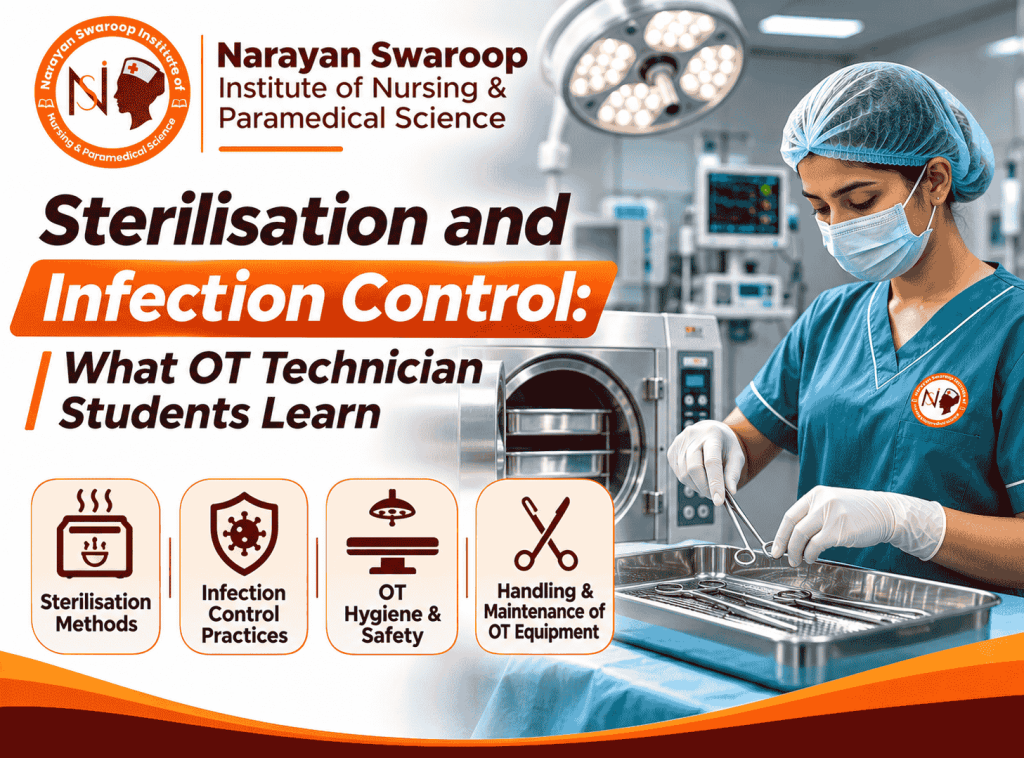

An operation theatre depends on more than surgical instruments and advanced equipment. Safe work also requires clear separation of clean and contaminated materials, appropriate hand hygiene, reliable instrument reprocessing and professional communication. OT technician sterilisation training teaches students why these systems matter and how assigned technical tasks fit within a supervised surgical team.
This is a conceptual learning guide, not a sterilisation cycle instruction sheet. Actual cleaning agents, exposure settings, equipment checks and release decisions must follow validated local procedures and competent supervision. Students should never improvise chemical mixtures or instrument-processing conditions from an online article.
1. Distinguish cleaning, disinfection and sterilisation
These terms are related but not interchangeable. Cleaning removes visible soil and other material as a prerequisite for appropriate processing. Disinfection reduces microorganisms to a level described by the selected method but does not necessarily eliminate all microbial life. Sterilisation refers to a validated process intended to achieve an appropriate state of sterility for the processed item.
The correct processing level depends on the item, its intended use, manufacturer instructions and the facility’s approved system. A student should know why instruments that appear visibly clean cannot automatically be treated as sterile. Understanding the difference is more important than memorising a single chemical name without its context.
2. Understand the flow of instruments
An operation theatre uses coordinated systems for receiving supplies, preparing sets and sending used instruments for appropriate reprocessing. The essential principle is that contaminated items should not enter clean storage through uncontrolled movement or handling.
During supervised training, ask how the facility distinguishes clean and contaminated zones and how staff document movement of instruments. Observe where responsibility passes from one team to another. Never open a prepared sterile package or handle contaminated instruments just to practise unless the supervisor has authorised the activity and provided suitable protective arrangements.
3. Learn hand hygiene as a professional habit
Hand hygiene is a foundational infection prevention measure, but it must be performed at the appropriate moments and with the method prescribed by the healthcare facility. Gloves are not a general substitute for hand hygiene. Protective clothing also has limits and must be used according to risk and approved procedure.
The WHO infection prevention resources cover hand hygiene, environmental cleaning and other core components. Students should relate these principles to the theatre environment while learning the specific institutional rules for attire, access and movement. A routine performed correctly every time is more valuable than a display of technical speed.
4. Why sterilisation monitoring matters
A sterilisation system requires documented monitoring and quality assurance, not a casual assumption that switching on a machine means the contents are ready for use. Facilities use approved checks and records appropriate to the equipment and process. Staff must know how failed checks are escalated and who is authorised to release items.
In class, focus on the purpose of physical, chemical or biological monitoring concepts as taught in the approved curriculum. Do not interpret unfamiliar indicators or declare a load sterile without the facility’s trained personnel. Learn to record problems honestly and remove questionable items from use according to local policy rather than hiding a possible failure.
5. Protect the sterile field
A sterile field is maintained through controlled preparation and behaviour. Students should learn why unnecessary movement, incorrect handling and breaches in technique matter. A person who notices a potential breach must communicate it through the proper channel.
Practise recognising common classroom scenarios: a package appears damaged, an item touches an unapproved surface or a supply has unclear processing records. The response is not to guess that everything is safe. Inform the supervisor and follow the approved replacement or verification procedure. The WHO surgical site infection guidance provides wider evidence-based context for infection prevention around surgery.
6. Environmental cleaning and waste separation
Theatre safety also involves appropriate cleaning schedules, surface management, segregation of waste and safe transport of used materials. Different waste categories may require different handling under facility rules and applicable regulations.
Students should learn how to identify a hazard, whom to notify and which tasks their training level permits. Do not use household cleaning advice for a clinical environment. Chemical concentration, contact time, compatibility and protective equipment are determined by validated procedures and safety documentation. An apparently small shortcut can create hazards for patients and other staff.
7. Team communication is part of infection control
An OT technician works with nurses, surgeons, anaesthesia professionals, sterile processing personnel and other support staff. If a set is incomplete or a safety check fails, timely communication helps the team address the issue before a procedure is affected.
Good handovers are specific: identify the item or concern, report what is known and clarify who will act. Never claim an instrument has completed a process that you have not verified. In training, practise using neutral language to report concerns without assigning blame. Patient safety depends on systems where staff can raise issues and receive appropriate responses.
8. How to prepare for OT practical assessments
Obtain the approved practical competencies from your instructor. Create revision cards for terminology, separation of clean and contaminated items, hand hygiene principles, instrument accountability and safety escalation. Rehearse only authorised simulated tasks under supervision.
After each session, write down one concept you understood and one question requiring clarification. Use diagrams to describe material flow, but do not invent operating parameters. Ask what the assessor expects regarding safety, documentation and teamwork. A strong practical answer explains the reason behind an action instead of treating sterilisation as a set of disconnected steps.
9. Assess a course before enrolling
A prospective OT student should ask whether the institution teaches infection prevention, supervised instrument handling and theatre safety, and how these competencies are assessed. Also verify the qualification awarded, recognised programme route, course duration and training facilities.
The institute’s OT Technician programme page is a starting point for enquiries. Request written clarification of what practical training is available and what graduates are authorised to do. A course brochure cannot by itself guarantee particular duties or a job after completion.
Frequently asked questions
Are cleaning and sterilisation the same process?
No. Cleaning and sterilisation have different purposes, and the correct complete processing pathway is determined by the item and approved protocol.
Can an OT student decide a sterilisation cycle is successful?
Students should learn the principles, but release decisions require authorised personnel following validated checks and facility rules.
Is wearing gloves enough to prevent infection?
No. Gloves do not replace appropriate hand hygiene, correct technique and other infection prevention controls.
Explore OT learning
Review the OT Technician course and ask the admissions office about curriculum and supervised practical training. The central lesson is simple: safe theatre support depends on disciplined systems, verified processes and timely communication.