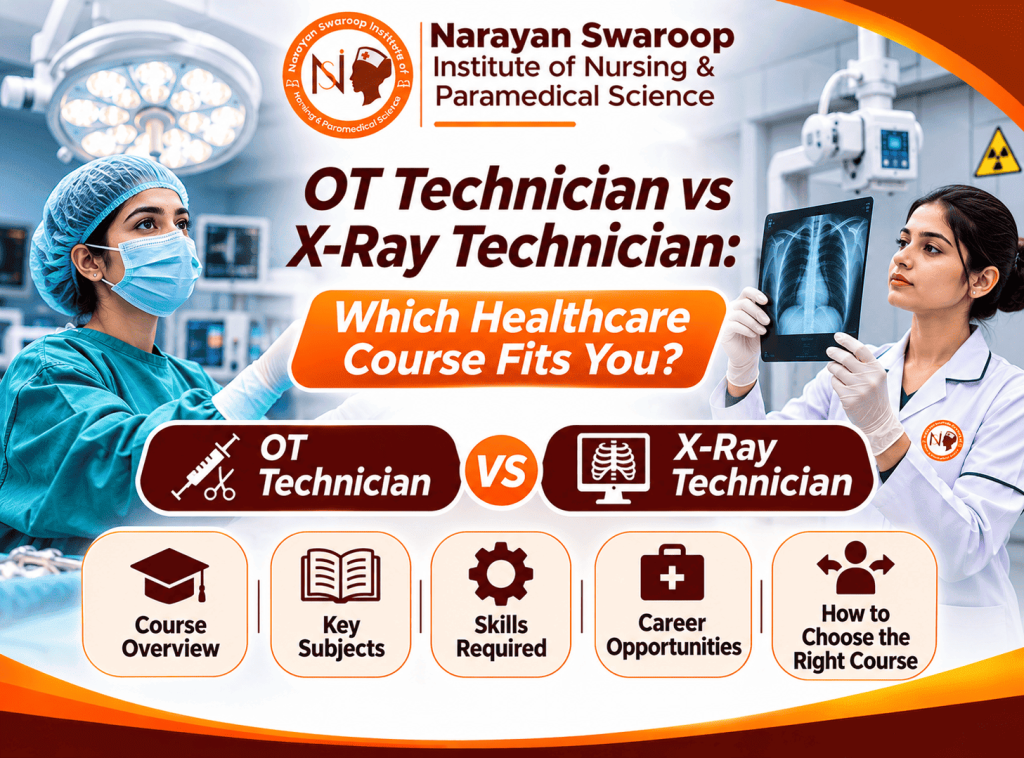

Students comparing OT technician vs X-ray technician often see both described as paramedical courses after Class 12. That label hides a fundamental difference. An operation theatre technician supports preparation and safe functioning around surgical procedures. An X-ray technician works within diagnostic imaging services, where positioning, equipment operation and radiation protection are central concerns.
Neither path should be chosen simply because the word ‘technician’ appears in its title. The daily environment, safety training, supervision and type of equipment differ. This guide helps students compare the work itself before reviewing admission details.
1. Understand the purpose of each role
An OT technician may help authorised surgical teams prepare the theatre, organise equipment and instruments, monitor readiness of supplies and follow infection prevention procedures. They work within assigned responsibilities and cannot independently perform surgery, administer anaesthesia or take on duties reserved for licensed professionals.
An X-ray technician, often called a radiography technician in particular programmes, assists with diagnostic imaging processes according to their qualification and the facility’s rules. Duties may include verifying patient information, preparing equipment, following positioning instructions and documenting imaging activity. Clinical decisions about whether an examination is justified belong to authorised practitioners.
2. The main difference is the working environment
An operating theatre is a controlled environment in which timing, sterility and teamwork matter. Staff coordinate with surgeons, anaesthesia personnel, nurses and other professionals. Work may involve preparing for planned procedures and responding appropriately when the schedule changes.
A diagnostic imaging department may see outpatients, emergency referrals and inpatients. The technician follows examination protocols while managing equipment, patient communication and radiation safety measures. Some facilities use several imaging modalities; however, an X-ray course does not automatically qualify a graduate to operate every modality. Actual scope depends on training and applicable authorisation.
3. Compare the subjects students should expect
OT-related study commonly introduces anatomy, physiology, surgical terminology, instrument identification, sterilisation, theatre organisation and infection prevention. Practical learning develops the habit of checking supplies, identifying contamination risks and escalating concerns rather than improvising an unsafe solution.
X-ray-related study usually involves anatomical positioning, imaging physics, image quality, radiation protection, patient identification and equipment care. Students should understand why an improperly positioned examination may require repeating exposure and why unnecessary repeat images must be avoided. Check the institution’s actual syllabus instead of assuming every technician certificate has the same depth.
4. Safety responsibilities are different
In the OT, a critical distinction is between cleaning, disinfection and sterilisation. These steps are not interchangeable. Teams must follow approved protocols for reusable instruments, hand hygiene, protective clothing and clean-to-contaminated material flow. The WHO infection prevention resources explain the importance of systematic infection prevention.
In radiography, radiation protection is a specific professional responsibility. Students learn principles such as keeping exposures justified and optimised, using authorised shielding and monitoring arrangements where applicable, and protecting patients, staff and the public. The Atomic Energy Regulatory Board’s X-ray safety guidance is a relevant Indian reference. Practical clinical work requires supervision and compliance with the facility’s safety procedures.
5. Which skills matter most?
For OT work, pay attention to calm teamwork, anticipation of equipment requirements, precision under time pressure and respect for sterile boundaries. Misplacing a properly prepared item or failing to communicate a concern can interrupt a coordinated procedure.
For X-ray work, spatial understanding, patient positioning, equipment discipline, respectful communication and careful documentation are particularly useful. Both roles require patient confidentiality and the willingness to follow authorised instructions. A confident student is not someone who ignores rules; confidence means knowing when to pause and request guidance.
6. Consider what an ordinary shift might feel like
Imagine a busy morning. In an operation theatre, the technician may check a procedure list, confirm prepared sets and support room turnover according to infection control policies. Work centres on readiness for the next case and coordination with the wider team.
In an imaging department, the technician may receive different examination requests, confirm identification, assist patients with positioning and ensure examination records are complete. The rhythm changes with departmental demand. These examples illustrate typical responsibilities, not a promise that every employer uses the same staffing model.
7. Compare course recognition and cost carefully
Ask about the precise qualification awarded, duration, subjects, practical hours, assessment and the authority overseeing the programme. The Narayan Swaroop Institute website has separate pages for OT Technician and X-Ray Technician. Review the actual documents supplied by the college before committing.
Do not assume that the word ‘diploma’ or a course’s advertising title establishes eligibility for a regulated technical position. Requirements may vary by employer and applicable professional regulations. Request written fee details including laboratory charges, examinations, uniforms and any clinical training expenses.
8. Use a decision checklist, not a popularity contest
Ask yourself whether you prefer the organised preparation of a sterile surgical environment or the technical and patient-positioning responsibilities of imaging. Consider whether you can follow strict infection-control procedures or carefully apply radiation-safety rules. Both environments can be demanding and neither guarantees a particular salary.
Next, ask the admissions office about opportunities for supervised practical training, equipment used for teaching and what graduates can legally do after qualification. If possible, observe a faculty-led demonstration. Avoid deciding from a single promotional reel or a friend’s unverified income claim.
Frequently asked questions
Is an OT technician the same as a nurse?
No. An OT technician supports defined technical tasks; nursing is a separate profession with its own education and registration requirements.
Can an X-ray technician perform any scan?
Not automatically. The qualification, training, institutional rules and applicable regulation determine authorised duties for each imaging modality.
Which role offers more patient interaction?
Both involve patients, but the contact differs. Imaging work often includes positioning and explaining examinations, while OT contact is organised around the surgical team’s care pathway.
Explore the programmes
Students from Prayagraj and Kaushambi can compare the institute’s OT course and X-ray course. For current entry requirements, equipment and fees, use the college enquiry form. Choose the type of work you want to learn, then verify that the qualification supports it.