
Medical imaging is a significant process that aids healthcare professionals in diagnosing injuries, diseases, and other illnesses. Of all the various medical imaging processes, X-rays are usually used for imaging bones, the chest, and some internal organs.
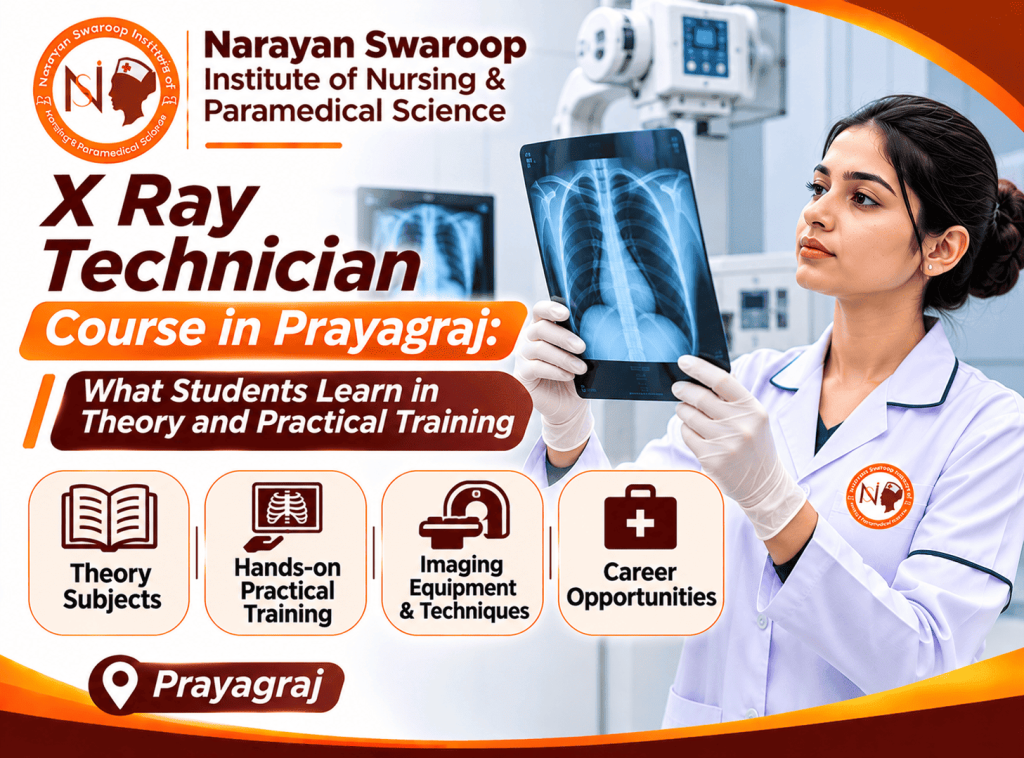
Students having an interest in the field of healthcare technology can join an X Ray Technician Course in Prayagraj to know more about the functioning of medical imaging machines and diagnostic imaging examinations.
In the course, theory and practical aspects are combined. Students will learn about human anatomy, X-ray machine, radiation safety and proper positioning of patients. Communication skills for interacting with patients are also learned.
Class 12th passout students looking forward to making their careers in the field of diagnostic healthcare should know the subjects and practical aspects of the course.
What Is an X Ray Technician Course?
Course in X-Ray Technique is a paramedical course, which teaches its students to diagnose diseases using X-Ray under professional guidance.
The X-Ray Technicians, whose names are sometimes called Radiographic Technicians in some conditions, perform functions such as handling the imaging machines, positioning of patients, and following safety procedures to obtain the diagnostic image.
Such images are helpful for diagnosing fractures, diseases of the chest, and various other diseases.
- Three main aspects of an X-Ray Technology Course in Prayagraj include:
- Theory: Anatomy, Imaging Techniques, and Radiation.
- Practice: Operation of Machines and Positioning of Patients.
- Safety: Radiation Safety and Healthcare.
What Students Learn in an X Ray Technician Course in Prayagraj
The theoretical education creates the basis for practice and using the equipment.
1. Human Anatomy and Physiology
Students receive the basics of human body structure.
The information about the structure consists of bones, joints, muscles, and organs. It gives students the understanding of the body part which should be examined.
For instance, if a doctor orders chest X-ray, students know how to place a patient.
2. Basics of Radiography
It is the imaging technique using the X-rays.
It gives the information about the radiation creation, penetration of the X-rays through the body and process of the image creation.
In addition, the information about the factors affecting the image quality is provided.
3. X-Ray Equipment and Technology
This course gives the students information about the elements of the equipment.
The themes may include:
- X-ray tube and generator
- Image detector
- Equipment control
- Image processing
- Equipment testing
4. Radiation Protection and Safety
Radiation safety forms an essential aspect of radiography training.
They learn that radiation can be reduced through proper positioning, good exposure settings, use of protection, and safety at work.
In addition, they learn that it is important for patients as well as healthcare professionals to follow the principles of radiation safety.
Practical Training: How Students Develop Clinical Skills
Training refers to the application of theoretical concepts in practice through real health care environments.
Depending on the type of training offered, training will involve demonstrations in laboratories, simulations, and experience through clinical practice.
Patient Positioning
During training, trainees will be taught how to position the patients based on the kind of examination.
This is because the positioning of a patient during X-ray examination of the hands differs from X-ray examination of the chest.
Positioning of the patient is very important as it ensures that useful images are generated and there is no need to perform repeated examinations.
Imaging Equipment Manipulation
Training will also entail training on imaging equipment and how to manipulate them.
This involves preparation of the room, listening to instructions, and when to get help.
Communication with Patients
Sometimes the patients may be anxious and/or uncomfortable during an examination.
Here, trainees will be trained on how to communicate effectively to patients by using proper language and directions.
Image Quality
Trainees will also be trained on the fundamentals of image quality.
They will be able to detect any problem associated with patient positioning and patient movement among others.
Eligibility and Course Duration
The prospective student who wants to be a candidate for X Ray Technician course in Prayagraj should ensure that he fulfills all the eligibility criteria before applying for it.
The eligibility criteria may vary in each course depending on qualifications and admissions process.
Following are some of the parameters a student needs to fulfill for his admissions:
- Qualifications: He must have passed 12th or its equivalent.
- Subjects: Some colleges may require him to study science subjects like Physics, Chemistry, Biology etc.
- Duration of the course: Certificate, diploma or degree may differ in duration.
- Admission criteria: It may differ in minimum marks, age etc in different colleges.
It is advisable for the candidates to check their eligibility criteria and course duration.
Key Skills Learners Will Acquire
The training of an X-ray technician is not only technical.
It also equips the learner with various skills including:
- Detail-oriented in positioning patients.
- Technically sound with regards to equipment.
- Communicating during examinations.
- Awareness of safety in the presence of radiation.
- Working together with the radiologists and medical practitioners.
- All these skills are useful in the diagnosis setting.
Careers after the Programme
Upon obtaining a suitable recognized qualification, students can try their luck with various job roles in the field of diagnostic imaging.
Some possible places of employment include:
- Hospitals with radiology departments
- Centres providing diagnostic imaging services
- Clinics offering x-ray services
- Facilities offering imaging services
The tasks involved might include helping in radiography exams, preparing patients and keeping track of examination records.
This will be dependent on the qualification, requirements for the profession and the employers.
Those interested in advanced imaging technologies can pursue higher learning, eligibility permitting.
How to Choose the Right X Ray Technician College
Prior to making a choice on which college to join, one needs to consider factors other than the tuition fees.
One can ask whether the program involves enough practical training and clinical training and radiation safety instruction.
One can also find out about the qualifications offered, any relevant accreditation, experience of staff, course length, and admission requirements.
One must not depend on advertisements alone and should seek updated information from the school itself.
Selecting the right program is very essential for becoming professionally competent.
Frequently Asked Questions
1. Are there X-ray technician courses for candidates after Class 12?
Yes, there are some courses which accept students after Class 12. However, subject combinations, marks and other requirements differ from course to course.
2. Is practical training a part of the X-ray technician course?
Practical training is an essential part of the radiography training program. The period and other details like facilities differ from course to course.
3. Is radiation protection included in the X-ray technician course?
Yes, radiation protection is one of the important areas of study in the radiography training program. It involves safety measures to minimize exposure.
4. Can X-ray technicians join hospitals for working?
Eligible technicians can join hospitals or diagnostic centers on the basis of employment criteria.
5. What are the things that a student must know before taking admission to the course?
The student must be aware of his/her eligibility along with the fees structure, practical training, course duration and award qualification.
Conclusion
An X Ray Technician Course in Prayagraj is a way for students to gain basic knowledge about imaging technology, human anatomy, radiation safety, and patient care.
Theory and practice prepare the students for future duties in the field of diagnostic healthcare.
Prior to application, it is necessary for the applicants to compare the programs offered, know what they want from their future career, and find out the new admission criteria.
To get the latest information about programs and admission criteria, the applicants may get in touch with Narayan Swaroop Nursing College.